Monday, March 30, 2015
Beginning to work
As mentioned, I'm finishing off a treatment for a script to be filmed, probably in a few months. I really am throwing myself into this, so much that I won't have a blog today, hopefully I might pull it off by the end of the day but right now my mind, at 8:17 am, all I can think of is this damn treatment.
Damn treatment?
It's funny how I really want to write a script but once I got the job, I don't want to write it at all. Especially early in the morning. I've already cleaned the kitchen, watered some flowers and made a list of food and disinfectant spray.
Really.
And I still have to put up my weekly list of people to call, email or write to. I have to send a book to a French film scholar who's doing an article on Ghostkeeper, the minor cult film I made years ago and still has an audience. And I also have to get a few copies of my screenwriting book and have to arrange to get an artist to do pencil drawings for my travel book, "How Not To Get Beat-Up In A Small-Town Bar."
Thinking of that, I might post the travel book information. It's a series of short and very short stories of incidents I've encountered on the half-million miles of travel through Canada and the western USA. Over a period of 40 years. It goes from truck stops to Area 51 to Roswell and even Sacagawea's son's grave marker in the middle of nowhere in eastern Oregon.
Curious?
But even now, as I write that, my little screenplay ghost is whispering, write the damn treatment, you're just making an excuse to not write.
So why do I write something else rather than the treatment?
Because I don't want to write the treatment. And I don't want to write the eventual screenplay either. I want to hit the road to Montana and Colorado and eventually end up in my home town in Manitoba in western Canada.
So why did I want a job and then get it and complain?
Because I'm a writer. And there's no fun having to write for money, because that means somebody else is behind it. A boss, a producer, an actor... whomever.
And already I am planning to go to REI, the camping/biking/mountain climber stores originally from Seattle. I just got my member dividend of $13.25 and I can't wait to spend it.
And now I'm looking for something else to keep me from reaching over my beautiful hand-made desk, built by another friend of mine who is a total craftsman. In fact I'm going to use up a few minutes to show you my beautiful desk.
That should take another 5 minutes. Then, I promise myself "enough", get to work.
I hope.
No more excuses... just one more thing... my desk.
Yeah, that's Jane Fonda just above the speaker phone. She has the "shag haircut popular then. I took that photo at the U of Detroit in 1971.
Okay, okay, I'm sorry.
Monday, March 23, 2015
A job... really.
Looks like I have a job.
I even get paid.
So what is it?
A former agent of mine sent an action screenplay I wrote two years ago called The President's Heart. It was enough for a producer and director to hire me to write a screenplay for them.
It's not a big movie, actually probably under $1 million. The idea came from them and is to be "A family in jeopardy."And it will probably go to netflix or someone else as well as international sales which will earn more than domestic.
So it means some money. But it also means something that's even better.
A credit on imdb.com
I'm sure most of you know imdb, or imdb.com. or IMDb.com
This is the most important thing to have if you want a career in the movie business.
Why?
Because that's where everyone goes to to see just who you are and/or who you say you are. Imdb started somewhere around 1990 by collecting names of film people, mainly actors, writers and directors. Then it began inserting everyone else who was on a movie.
Today it has over 3 million titles (movies) and over 6 million personalities.
And yes, I'm one of them.
But so are everyone on the movie from producer to writer to actor to grip and so on.
And why is it important?
Because if your name isn't there, you're nothing. And I don't mean that personally, it's just a fact that shows that either you're in the business or not.
And if you're not, or if you haven't worked lately, it also shows that. And that's not good. For example, my last movie produced was 2010. This new movie I'm writing will be made in summer and thus my name will be pushed ahead five years to 2015.
Which means I'm not dead.
Or unemployed.
Or both.
But there is a bad part to IMDb.com also. Your age. I made a big mistake writing my age on other websites and now it appears on IMDb.com.
So what does it matter?
Ever hear of "it's a young man's business."
But needless to say, all that matters is that you have a recent credit. If I'm lucky I might get two or three credits this year. My French connection movie looks like it might film in late summer in France.
And yes, I'm going to France to hang out and eat real croissants. And vin rouge. Oui?
Here's what it sort of looks like... the first line is all the jobs I did besides writing.
Filmography Jim Makichuk
Jump to: Writer | Director | Producer | Miscellaneous Crew | Camera and Electrical Department | Editor
Hide
Writer (17 credits)
2010 The Town
Christmas Forgot (TV Movie) (written by)
2004 Maiden Voyage
(TV Movie) (story) / (teleplay)
2004 Target
2002 Greenmail
(Video) (written by)
2002 Gentle Ben
(TV Movie) (teleplay)
2001 Rough Air: Danger
on Flight 534 (TV Movie) (written by)
1999 Roswell: The
Aliens Attack (TV Movie) (written by)
1998 Dream House
(TV Movie) (written by)
1995 Highlander
(TV Series) (written by - 2 episodes)
- Star-Crossed
(1995) ... (written by)
- Blind Faith
(1995) ... (written by)
1994 The Odyssey
(TV Series) (writer - 1 episode)
- The Greatest
Show on Earth (1994) ... (writer)
1991 Lightning Force
(TV Series)
1991 Mom P.I.
(TV Series) (written by - 2 episodes)
- Cash and Money
(1991) ... (written by)
- A Fugue for Mr.
X (1991) ... (written by)
1990 Blood Games
(story)
1988 Betrayal of
Silence (TV Movie)
1985 The Tower
(TV Movie) (as James Makichuk)
1984 Heathcliff &
the Catillac Cats (TV Series) (1984)
Wednesday, March 11, 2015
Selling yourself
I have just ended a writing job, or at least I think I have. And I wish I have.
A director and producer here in L.A. read a screenplay of mine which was basically an action-thriller with a budget of at least $10 million or more. So these two culprits decided to ask me to write a screenplay similar, but for less than half a million.
This is how it works with some of the low-budget people in Hollywood. How they decide that a story based on a family in the woods that is just as good as the $10 million script I have, I don't know.
They're only suggestions were these words;" cabin in the woods" and "family in jeopardy. "
Oh and could I insert some of those nifty hunter's cameras, the ones that hunters and others nail onto a tree so they can see if any animals have come their way.
And that's pretty much all of their ideas for their great movie to be.
But first, the pitch.
"The Pitch" is one of those things I truly hate, in my book, "Working Writer's Screenplay," I include a few pages wherein my producer friend and I went to CBS to pitch a movie. And I repeat, I hate pitches. And the dirty secret is, you don't always need to have one. Or you get someone else to do it.
And that's what I did with my friend, he was a producer at ABC years ago and even optioned a screenplay of mine, that's why I call him a friend. And he is a great guy, knows the business far more than I do. Or care.
We divided the job; he was the color guy, the guy in the booth at a football game, and I was the side man who would jump in when there was something specific. Like "the family is stuck in nowhere."
I had the beginnings of a screenplay based on a real-life story that happened to me and my ex-partner and her three kids.
So Norton (the pitcher) went at it, he stood up, moved around, swung his arms, really good. I wish I could do that. My part was when he'd turn to me and say, "What happens next."
And I say; "They're stuck in a small town in the middle of nowhere. In fact the name of the town was Nowhere." Then Norton would pitch again. Eventually the woman we pitched to was "a big fan" of both of us. That meant several things; that she liked the story, or she liked it but didn't "have a home" for it, or "what else do you have."
In this case, she liked it and would present it at the next meeting.
Which is good.
But it turned out that CBS was doing bio-pics (true-life stories).
So back to the two producers with hunter cameras, etc.
They wanted a pitch, which I sort of wrote and wished Norton was around. They read it and wanted more. At this point, I really didn't like either of these guys, they were supposed to give my agent an "executive producer" position and never did, and they gave me a deal that was really bad.
So I quit.
Or they quit.
I never responded again and they didn't.
Oh, I forgot, one of them wanted me to write a screenplay about a family in jeopardy. This was about 15 years ago. And he wanted me to write it for free.
But I had one over him, because I wrote the script but never signed the contract and got an option fee on them if they wanted to show it around.
They were mad.
I had $2000.
Isn't this business great?
Tuesday, March 3, 2015
The music documentaries to see
Well, all the awards have been given out for another year, oscars, Golden Globes, etc. etc. Looking back at 2014, I started doing taxes and realized that I paid to go see 2 movies. That's it. Dawn of the Planet of the Apes and Interstellar. Neither were great, maybe okay but not great. The rest of the movies I saw on dvd screeners, which are handed out to members of writers guild, directors guild and actors guild members (although not all actors get screeners considering there's over a hundred thousand of them.)
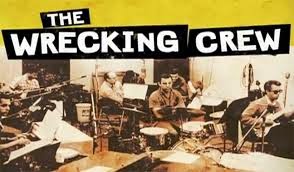
I'm looking forward to seeing The Wrecking Crew, a documentary on a bunch of studio musicians who played on almost all the rock and roll sessions for bands like The Byrds, Mamas & Papas, Beach Boys, The Monkees, Simon & Garfunkle, John Denver and on and on. Virtually some of the best music for the boomer generation. Like me.
There were also some band members who went out on their own, musicians like Leon Russell, Dr. John and Glen Campbell, probably the most famous of any of the crew. I read the book a few years ago and was waiting for the doc to come out.
And as long as I'm on this line, check out a few other docs that are exceptional.
Beware of Mr. Baker is 90 minutes of watching a truly insane man, Ginger Baker who played with Led Zeppelin, Cream and a few other bands.
There's also Mussel Shoals, the east coast version of The Wrecking Crew who played backup on hundreds of songs that became hits.
These guys played for Bob Seger, Rolling Stones, Simeon & Garfunkel, Bob Dylan and tons of others who came to this odd little town on the east coast.
There's also two mega-docs on music, being Tom Petty's band which is about 7 hours long and The Eagles, which is around 4 hours long. Bring popcorn. The Eagles, in particular is quite candid in their arguments and after a while you just want them to play the music. These are all available on dvd, don't know about streaming.
Go to Materials on the left side of the blog to see the Wrecking Crew trailer video.
Anyways... a little departure from films with actors.
Tuesday, February 24, 2015
No surprises
Had too much work yesterday to blog.
Watched a bit of the Spirit Awards on IFC, which "used to be" about independant films, you know the films where people scraped up enough money to make a little movie anywhere from $25,000 to maybe $500,000.
Well, those days are gone and the films that were up for awards at the Film Independant party on Venice Beach Saturday night before the Oscars. For one thing, a lot of the independent films were the same as the Oscar films. Almost all except for Clint's American Sniper, which made more money than all of the other films put together.
So what's the difference between the Spirit Awards and Oscar nominees?
They all have major actors in them. Stars, as we say in America.
So what happened to those cheapie little "indie" films?
They got famous actors who earn millions of dollars.
Why did they get famous actors who get paid so much?
Because famous actors like Jennifer Aniston will do anything to get a shot at the Oscars by playing a role that isn't dumb movies like Aniston usually makes. So they defer their big salaries in hopes of their peers acknowledging how wonderful they are and that they worked on a real heartfelt movie.
And as far as budgets, indie films now are considered to be "indie", have budgets lower than $20 million. Fifteen years ago budgets were all under $500k with unknown actors, writers and directors. That's gone, only the big guys can make small movies now.
And it was sure there at the Oscars.
The only real "Hollywood movie" was Clint's and was totally ignored. Because it made money.
Personally I thought it was a dull show, Doogie Howser is a good actor but not a presenter. Ever since Bob Hope, Johnny Carson and Billy Crystal left the Oscars, there hasn't been a really good host.
Hope and Carson are gone, of course, but Billy is still around. Too old, I guess.
Ratings for Sunday's Oscars were 16% below last year and the lowest rating since 2009.
I was glad Eddy Redmayne won for The Theory of Everything. It seemed to be very international, with British winners and Mexican winners.
But I still think the best film I saw this year was Nightcrawler with Jake Gyllenhaal.
Gotta get back to work.
Monday, February 16, 2015
A Canadian screenwriter
Last week one of the earliest screenwriters in Canada passed away. When I say "earliest", there weren't a lot of feature film screenwriters in Canada until the early sixties.
John Hunter was one of them, born in 1938, a Manitoba boy just like me.
He was one of those people who helped the fledgling Canadian film industry discovered, or maybe discovered the film industry itself. There were films made by the National Film Board of Canada, but we really never included them, as they were government films showing wilderness films and animals and maybe a few Eskimo documentaries (now called Inuit).
NFB as we knew was very hard to get into, almost impossible.
The first time I saw a true independent feature was in 1969 by a filmmaker called Don Shebib. And he made Going Down The Road for around $25,000. There were always Quebec films but English Canada finally had our own filmmaker. I remember him coming to our TV station and we were all pumped up to see a real Canadian film.
John became one of those pioneers and while Hitchcock started with silent films, we were a little bit behind but caught up quickly.
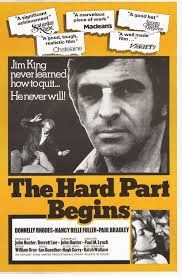
John's first feature, The Hard Part Begins, was very much what the Brits called "kitchen dramas", which was usually about losers, in fact so was Goin' Down the Road. I was never really sure why we made so many of these sad stories but eventually they began to open up.
He set his story around a country singer facing the fact that he's almost over as far as being a music star. And to make it even worse, his female singer is getting offers, without him. While this sounds sad, John found nobility in the singer and even set his story in Paris, Ontario. Yes, there is one. The movie is gritty and the music was amazing.
This was a big deal for filmmakers, that we could actually make movies without NFB. And John followed up with more gritty stories about characters that get lost along the way. He also referred me to Paul Lynch, a director who filmed several of John's screenplays. I happened to be at a party in Toronto and was introduced to Paul, who immediately said that "Hunter" as we called him, said I was a reasonably decent writer.
It led to an agent in L.A. and the rest of me is in my blog.
But back to John. He met another friend of mine, Phil Borsos, who I talk about previous to this blog. Just go back to Feb 9, 2015 for that blog.
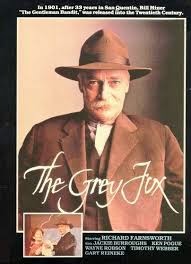
What happened next is that Phil always wanted to make a western based on a true story about an aging American train robber coming out of jail and deciding to rob banks in Canada, which were rarely if ever robbed.
What came out of the collaboration of John and Phil was arguably one of the best feature films ever made in Canada, The Grey Fox. It won the Canadian version of an Oscar, the Genie, and took home at least 20 wins that night including two nominations from the American Golden Globes.
I'm not sure if any other Canadian film ever won so many awards.
After that I met John now and then, we seemed to be on different sides of the country, but when he lived in Vancouver, I would drop by and he would talk about movies and why some are good and why some are bad. And why we have to write.
One of the last times I saw John was In Vancouver and met with Gary Fisher, another close friend to John, and we swapped our usual stories about bad producers and why it was so hard to make films in Canada.
I met John again in 1995 when Phil passed away at age 41, and we both sat and talked about Phil and about what we would miss about him.
Ironically, John passed away on the same day and month as Phil, 20 years apart.
I always treasured those moments with John, he had a subtle sense of humor and always was graceful and ready to help those moments of emptiness that writers fall into.
Monday, February 9, 2015
On talent
Webster's definition of talent is "any natural ability or power." So what does that mean, specifically. The closest in a Gallup definition focuses on one word, "natural".
But that still doesn't really explain what talent is, or who has it and who hasn't.
Take me.
I often get told that I have talent but the truth is, I don't have talent. How do I know this?
It goes back to my short time in film school in the Canadian Rockies where I attended the Banff School of Fine Arts. The fine arts were mostly music, art, photography, singing and all those other arts.
What was I doing there?
Well, my then wife Brenda and I spent the summer there, her taking photography and I took a film
course. The thing here was that I had already worked in television for 2 years and probably knew more than the teachers. I didn't really care because this was two month holiday for both of us.
It's also where I met Phil Borsos, a 19-yr old filmmaker from Vancouver. We both liked each other's work and made our obligatory short films together. It was the beginning of a great friendship. And it was a lesson in how to make some success in the world of film and TV.
Every class member had to make a short film over the two months we were there. I had no great ideas so I made a 10 minute documentary of the town, playing with the idea of the tourists below the school and the school itself, set amongst the incredible Rocky Mountains. Brenda shot this photo of us, Phil on left with shaggy hair and me with beard.
Phil's idea for his short film was about a trumpet player who blows himself up.
See what I mean?
I made my film by walking around town and filming tourists and then artistic people at the school. Very lazy.
Phil asked me to shoot his short and we had to hoist heavy wood doors up 8 stories of the school's residence just so that Phil could put the actor up higher than the mountain view.
So, who's the one with talent?
Obviously, Phil.
We both said goodbye and left to our respective homes, Phil in Vancouver and me in Windsor, a little city across from Detroit.
Two years later, and me getting fired at a TV news network, I ended up in Vancouver as Phil
and I always talked about starting a company. So we did. Rocky Mountain Films. And we shot a short film about a Cadillac car and a car salesman. It didn't do much. I'm on the dolly and he's kneeling down.
Then Phil came up with another idea. He wanted to make a short film on a barrel maker who made wooden barrels for whisky. In fact it was one of the few remaining barrel factories in the world. Phil had seen it as a teenager and always wanted to make a film of the place.
So we started to make the film with help from the NFB, also known as the National Film Board, a government agency that made films and assisted people making Canadian films. They gave us film stock (no Digital at that time, 1975), and cameras, one Arri S and a French Eclair camera. Both were 16mm film cameras.
Right from the start, Phil had the crazy ideas, and they always worked. I easily shot the scenes he wanted and it was a lot of fun. I was working at a TV station at the time, 4pm to 10pm and after a week of filming, I was exhausted between the two jobs. We got another cameraman, Tim Sale, to finish the film.
After that, we gave it to an editor, who was pretty tough and hard to work with. I got a job at a TV station in another province and then Phil called and said it was done. I flew there and looked at it, it was pretty good. It was called Cooperage, which is the technical name of the factory.
However the NFB said it didn't have it's standards. Simply put it was inferior.
We thought we liked it.
We liked it so much that we made a 35mm print, now 15 minutes long, and put it into the 1976 Academy Awards.
But before that, the Canadian film awards came and guess who won for Best Short Film?
We did.
We beat every NFB film that year.
It felt good.
And then, the Academy Awards came and we didn't win. But we were finalists.
So where does this go?
It's where I learned how to stay in the film business, by finding someone who really is talented and someone like me who worked very hard and very stubborn. If I wasn't talented I was gonna be as good as I could.
And I did that. And am still doing that. But without true talent, I would never have made it this far. And maybe Phil wouldn't have made it without my ability to film and to come up with ideas and that both of us loved making Cooperage so much.
We stayed close friends for years until, at age 41 in 1995, Phil passed away from leukemia, way too early. It was around this time of the year.
I miss him dearly, and keep in contact with his wife and his two sons, both incredibly talented.
So that's what talent is. At least to me. Go figure. Paul Newman once said that acting was very hard for him, he didn't really have a talent for it and had to work very hard.
I like that.
And one more thing; both Phil and I were the only two people in that film class that failed.
We failed totally.
But as of this day, nobody else in our class ever came even close to our accomplishments. And as for the course, in hindsight, both my ex and I agree it was one of the best years ever.
Subscribe to:
Posts (Atom)
.jpg)