After long consideration, Disney has decided to go with a western movie with Johnny Depp for $215 million. The original budget was $275 million and Disney was worried, but now that it's only $215 million, all is well.
The movie is based on a 1950's TV series and 3 movies and it was called The Lone Ranger. The Ranger traveled the west with his trusty Indian friend, Tonto, dealing out justice to bad guys. I used to watch the series all the time and still find one of the feature-length movies on TCM.
In hindsight, they were pretty simple stories of morality, good guys win, bad guys lose. They were okay for a kid like I was, but now, older, I realized they weren't that great even for their time period.
But back to the question of movies and whether they matter. The previous blog dealt with the business end and this blog is about the content. At the beginning of the digital age a saying came into place; "the good news is that everyone can make a movie, the bad news is that everyone can make a movie".
And there have been a lot of bad movies lately. Some well-meaning, but simply not very memorable. And it's worth it to remind you that there were always bad movies. But what is happening is that the good ones really aren't great.
There's a theory about people who watch a movie a couple of times over a period of time. It basically suggests that what you remember is not really the movie, it's the memory of the movie, what you remember about that evening as much as what you saw.
I do this with Easy Rider, sometimes I watch it and it's great, other times it feels dated and sometimes just corny. But then, there's The Searchers, one of my alltime favorites and what's interesting about this one is that I still enjoy watching it.
Okay, I remember going to Easy Rider with a date who wore a mini-skirt just after they all came out in around 1967 or so. And it was a mini that could take on any clothes of today.
And I remember The Searchers, seeing it as a kid of 10 in a small town theater. Yet every time I watch it, and I've seen it at least 30 times, it's always new, there's always something in it that I didn't catch before.
So what's the difference?
It's a better-made movie. Directed by John Ford, who won 6 Oscars in his career and who had a way to make the movie better. Ford had a way of putting little idiosyncrenicities into his characters and scenes, little bits as actors call them, the way someone rolled their cigarette or rode a horse or just spoke. Little things that made them human. And usually things that producers hate because few producers really understand the subtleties of life.
And knowing those subtleties means you have lived life.
But there was something that all the movies had up to the 1990's. They were the event. You would talk about going to see the latest movie on Fridays, there was no iPhones or iPads or tweets, just the movies. And TV of course, but TV didn't spend the money that movies did, movies were truly bigger and wider and louder and more exciting.
TV was related to doctor shows and cop shows and lawyer shows. Ironically the same as now. But then there came the CSI shows which pushed the envelope in terms of filming like a movie. This new way to shoot TV dramas started some time ago, the X-Files was one of the first to shoot dark images and shadows.
With digital cameras they can now give TV shows the look of a movie, any CSI episode that show you that.
That hit the movies hard, not to mention that a whole new generation of writers who were raised in relatively easy lives that gave them little inspiration beyond writing shows that copied the TV shows they saw as kids.
The great writers came from WWII, they either served or they were kids and many of them were outsiders, guys mostly, who came back from the horror of war or hitchhiked across the country, riding trains, working in fields, living life. And they usually wrote great scripts although mixed in with a few bad ones here and there.
What they wrote about were issues, disguised as entertainment. There was always a bigger picture than the story. Take Steinbeck's Grapes of Wrath, about migrant workers in the 30's. The book caused a stir in America, Republican politicians condemned it. And John Ford made the movie in 1939 and Republican politicians threatened to have it pulled from theaters.
Most of the great movies have messages that stir the heart and mind, and most people don't get them, but that doesn't matter, the message is still there. Of the movies now, I would say Avatar had that, it was essentially a 1970's script with 21st century CGI. This year's Woody Allan movie also has a bigger message, that the past isn't always as great as you think, it's just the past.
One of the best younger writers around now, although way past 40 is Alan Sorkin, and if you want to read the hell he went through just in his personal life with drugs, you can see why he's good. He's been there.
Each week in LA there are 5 to 10 new movies released, most of them independent movies where the distributor rents a theater for 2 weeks to say the movie played "theatrical", which enhances it for DVD distribution (and now streaming). And most of them are not very good, some weeks they're all really mediocre.
So what do studios do? You know that, bigger and better.
Remember the Lone Ranger? On TV it was a fairly inexpensive show, but with Johnny Depp, it's going to be $215 million. We're talking about a couple of horses, some wide open spaces and some gunfights. $215 million?
How can a western cost that much? Well, Johnny gets his piece. But after that, where is the money going to be spent? Cowboys and Aliens wasn't a success, considered a flop even with Harrison Ford although Harrison is getting long in the tooth. And it didn't cost as much, even with massive CGI effects.
And the best part is this; they're re-arranging the movie just slightly. Instead of the Lone Ranger being the lead --- Tonto, his faithful Indian companion is the lead. So it's The Lone Ranger, but the Ranger plays second fiddle. In a genre that only anyone over 45 can relate to. And they stay home to watch CSI.
At least in the series, Tonto was played by Jay Silverheels, a real Indian from Canada.
Now to see The Lone Ranger from the 1950's go to Materials and click on LONE RANGER.
There is a great amount of debating going on now in the movie industry. In short, it comes down to that famous and overused saying from William Goldman.
Nobody knows anything.
Movies have changed dramatically in the last 5 years. DVD sales have slumped as people prefer to rent from Netflix and Redbox and that approaching gorilla, streaming video. And if the studios are wondering why they're beginning to see sales of movies go flat, they just have to look in the mirror.
First let's look at the business end.
Studios made a lot of money on VHS movies, both for sale and for rent in both corporate video houses like Blockbuster and mom&pop shops. It was a whole new way to get money from their vast libraries of movies. They discovered that not only new movies were sought, but also old ones too.
It was good times.
Then DVD entered the picture, and it was even better as they realized that customers would not only buy the new DVD movies but also would buy the old movies they already had on VHS but wanted the superior pictures of digital video. This also happened when people began to buy CD's to replace cassettes and vinyl records.
It was good times again.
And then the studios got greedy and said "let's sell movies everywhere!"And DVDs began showing up in your local supermarket by the movie magazines at the checkout. They were everywhere, the pharmacies, gas stations, liquor stores and finally -- the Red Box.
The Red box, usually at supermarkets but now in other stores, was simple, like buying a chocolate bar. Simply slide in your credit card and get a movie for $1. Yes, one dollar.
But some other people did not like this at all. Who?
The theater owners, that's who. Movies were coming out too fast from the studios. And networks began to show their old shows on the internet. For free.
So who was losing money here? The theater owners who depend on movies playing at their theaters for as long as possible. That's how they make money. And releasing movies too soon takes money away from them.
And that's where we are now.
This week, a movie called Tower Heist with Eddie Murphy and Ben Stiller was set to open Nov. 4 and then be released 3 weeks later via VOD (video on demand) to 2 sample cities, Portland and Atlanta where people could pay $59 to see it at home.
Do you see something wrong here?
Without debating the worth of that particular movie, except to say Eddie Murphy movies have flopped for the last 10 years, the thing here is this: The theater owners were afraid that could cut into their ticket sales. Most big movies last at least 3 weeks in theaters.
And would you be willing to pay $59 for any movie 3 weeks after it's released rather than wait for a few more weeks to buy it at $9.95?
So the studios now have backed off and everyone is still unhappy because sales are dropping steadily. And studios wonder how they can bring back those heady days of VHS again, this time with the internet being another big gorilla in the room.
There are two things that I can see; first the studios oversold their movies and in doing so made movies less important. Up until the mid 90's movies were still a big-ticket item, they were special and you would go to see movies in theaters.
By putting movies into any store that had a counter, I think that it made movies less special. You can buy a movie and corn flakes at the same store. And Red Box was renting the for $1. And movies lost their magic.
And secondly, we have a generation that's used to getting things for free (except anything from Apple whose mark-up is outrageous) and that includes movies.
What's the solution? Need I say it again? "nobody knows....
But there's another side to the movie problem... but that's for the next blog.
A relatively unknown man named Ralph Steinman died from pancreatic cancer three days before he could receive the Nobel Prize for medicine, shared with two partners. Coincidentally he was Canadian. The irony is that he never learned that he would be receiving the Nobel Prize.
What he did is discover the dendritic cell which his fellow scientists say has greatly enhanced how the body's immune system works and has paved the way for cancer treatments and other diseases. Not a cure, but something that will bring a cure closer.
A few days later, Steve Jobs also died of pancreatric cancer and the world watched endless hours of tributes and millions of tweets from the man who gave us the MacIntosh, iPod, iPhone and iPad and how much he contributed to the world.
No, I'm not going to trash Jobs, he did not deserve to die so young and he was one of a kind. But I think that now, in the next week or so, we'll begin to see editorials and letters about his failings and I guess it's inevitable that such a huge reaction will be followed by those who will bring out his almost draconian corporate rules, his revenge against those who opposed him and the poor condition of the Chinese factory workers, 10 of them who leapt to their death because of harsh work conditions.
But I found it interesting how pancreatic cancer involved both of them, the scientist who was and trying to find a cure and one of the innovators of the personal computer who created products to entertain us.
So yes, I just got tired of the constant coverage of Jobs, yes, he was brilliant. But so was Steinman and he got a quarter of a page for one day.
The interesting thing about Steinman, is that after he got pancreatic cancer, he chose to become a test tube for any kind of treatment that was available for study. Since he was dying, he figured he'd continue his study of immunity as far as his body would let him. He was also named co-recipient of the $500,00 Albany Medical Center Prize, the largest award in medicine in the U.S.
Watching the Jobs coverage I wonder where our values are now. What's more important; a cure for cancer or an iPod that plays 15,000 songs. I guess it depends on one's values.
Jobs was responsible for opening up the world to some extent for the blind and deaf, but he wasn't the innovator nor the only computer manufacturer to do so. And as far as the iPod, Sony came out with the Walkman in 1980 and it was a major change in that one could carry a small portable cassette player with them all the time. With earphones too.
So why all the attention for Jobs?
Well, first of all we now have more media coverage of everything than ever in the history of the world. Something happens in Uzbekastan and we hear about it immediately, that is if it has a good hook. As the old news saying goes, "if it bleeds, it leads". When I worked in TV news, both as writer, cameraman and soundman, I learned early that news was when something bad happened to someone.
But we now have, thanks to Jobs and Gates and all the others, the ability to instantly tell the world what we feel. And it's infectious; one starts and then another and then millions and pretty soon it's a movement and everyone wants to be included.
And so what Jobs helped create was also the reason that the outpouring of tributes and messages in the millions took place. Remember that Americans in the west didn't know that Abraham Lincoln was president for almost 2 months.
When Michael Jackson died, his family and the world mourned the "greatest entertainer ever". Was he the greatest? Nobody really knows as most of our perceptions are based on the values we have now, the world is a little smaller and to some, everything's been done. All we're doing is refining it.
Did Michael change the world? Not as much the Beatles did. They literally changed the world, people began to dress like them, more bands than ever in history were formed by teenagers, including me and long hair... well it's still a style today.
But the world again rained tributes and messages to them and to each other. A celebration of being part of something big.
So consider that the media, mostly TV and internet and newspapers, now run 24 hours and thus need content. So when someone important, or mildly important dies, they jump on it and try to find family, friends or anyone who they can interview in their "breaking news". Jobs was a natural, a California boy and he did change his world, primarily that of how to listen to music and extending the idea of a laptop into the iPad.
Steinman got a short mention as did his 2 partners, for their research. They didn't appear on CNN or MSNBC or ABC or any of the news shows. CNN seemed to run almost 24 hours of Jobs and in the LA Times today an article talks about "a world without Jobs".
So who's the guy above with lightning in his hands?
Nikola Tesla was arguably the 20th century's greatest genius and most people have never heard of him. Among his amazing inventions was invented A/C power, you know, that outlet on the wall that you plug your computer and your TV and your radio and your refrigerator into. Where would Jobs be without Tesla. Or us?
The LA Times had a headline Saturday that read "What will the world do now that Steve Jobs is gone?"
Well, it will continue. Genius is unique, and he had that. But genius isn't all that uncommon. When Alexander Bell was developing the telephone there were at least a dozen others who were working on their telephone at the same time. Bell never patented his telephone until his father-in-law actually went to the patent office and had it patented.
Two hours later another inventor came in to patent his phone, similar to Bell's. But it was too late. Had Bell not got his phone patented, he would never had the recognition he has to this day. Bell is a common word now.
Genius comes and goes, and there's always someone else out there who has the next great idea and there's also some scientist who sits for hours in a cramped lab somewhere who will also come up with one more advance in medicine, influenced by Steinman and probably listening to his iPod.
For the record, I have 4 computers, 2 Dell laptops and 2 Mac's (although one is ancient). And an iPod.
I met Morrie Ludwig when he took a screenwriting class I taught at UCLA extension back around 2003-04. My classes were online rather than classroom and I found this method far better than giving a lecture and then having a student read some of their pages in a 2-hour frame.
While it meant more work, which ultimately was the reason I left after nearly 3 years as it began to interfere with my projects and at $180 week hardly covered the hours I spent. One of the differences between classroom and online was that online I was always available to the students, 24/7 as they say. Classroom instructors interacted with their students 2 hours a week.
I spent a lot of time talking to students through email almost every day and had the habit of writing a lot of notes and comments, which I would post on my course page. Students would also post their work for me and for other students to comment on. I still feel this method is much better than classroom in spite of the workload.
Eventually the workload became too much, especially after one semester where I had 15 completed screenplays anywhere from 70 to 130 pages in length. As I tended to give initial notes of anywhere from 4 to 8 pages, it took me a full week to write those notes and taking entire days. It just wasn't worth it anymore.
But back to Morrie.
He first emailed me that he was having trouble with the online application. It wouldn't accept his birthdate. I wasn't sure what he meant but was surprised to find out the reason.
Morrie was born in 1912 and the computerized application refused to acknowledge the date.
He was 91 years old.
We exchanged emails several times during the first week of the course and then I found out something else about Morrie. He was born in Manitoba within about a hundred and fifty miles from where I was born.
Both of us left Manitoba at the age of 12 as well. I moved with my family to Southern Ontario and Morrie left for San Francisco. Our emails began to talk about our lives, me in my early 50's and he at 91. I found out his wife had passed away and he had always wanted to write a screenplay so he took my course.
Morrie had already written a screenplay on his own, a golf story. And it was pretty good. My course was about writing a new screenplay and he was ready. As the months passed, Morrie moved to Los Angeles to be with some family as he was alone up north. That's when we decided to meet.
I chose the perfect restaurant, Musso and Frank's, which opened in 1919. Known for the movie stars, writers and other celebrities over the years, the restaurant still hangs on to it's traditions and going there is stepping back into history.
We hit it off perfectly, each told stories about our upbringing and started a friendship that would carry on for 3 years. He took one more class and then decided that was enough but by then he moved to a senior development where he bought a very nice 2-bedroom home overlooking an open green space.
I would drive to Palm Desert every two months or so and we would make dinner for his brother and his wife as well as his 75-year old niece who begged him not to reveal her age to her 70-year old former bandleader.
For me it was a time of listening to stories about big bands, adventures and old friends as I sat and listened. Morrie had maculer degeneration in his eyes but he could still fire off a handful of golfballs to within a few feet of the hole from 20 feet away. "It's the feel, not the eyes", he would tell me.
And he wasn't above flirting with a lovely barmaid in Palm Springs, or any woman for that matter. And as I was by far the youngest person around, I got a lot of attention from the ladies in their 80's and 90's. One even showed me her nude painting done when she was thirty.
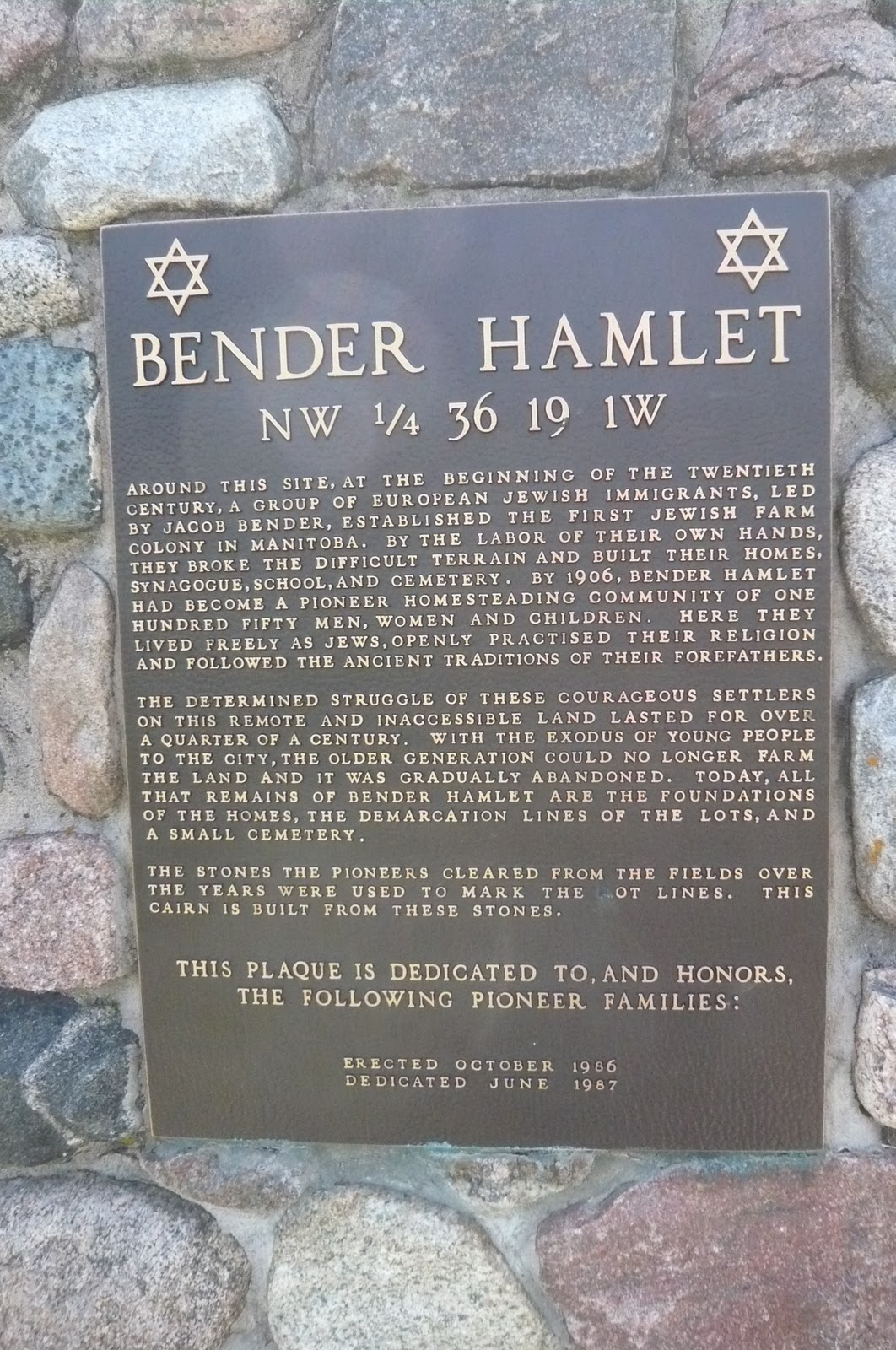
On one of my trips to my home town in Manitoba, I took a side trip to where Murray grew up to the age of 12. It was an empty field and a stone monument stood near the gravel road. No cars passed and only a few cows watched me for a moment or two.
This was Bender Hamlet where he was born. It was founded in 1906 and a small group of Jewish settlers attempted to work the land. Unfortunately the land was very poor and rocky and they struggled until many left for Winnipeg. There was no real indication that anyone had every lived there now, just the wind and the rushing sound of poplar tree leaves.
Morrie had funded the plaque back in the 1970's and it still stood there in perfect condition. I had taken a Sears catalog I found and took a handful of popular leaves as well as some prairie flowers and pressed them in the thick catalog.
Months after I gave the leaves and flowers to Morrie and tears began to fall. He hugged me and said "thank-you". Poplar trees are in the aspen family and their leaves have a distinctive sound that anyone who grew up on the prairies immediately recognized. It may sound kind of dorky, but it's real.
Later my brother visited Morrie with his family and Morrie again was the gracious host. He even had an "affair" with a lovely woman in her 70's, which he described to me in detail.
As things happen, I went home to Canada for Christmas and when I returned and called Morrie, his phone number was gone. He had passed away at the age of 93, peacefully in his sleep.
Last year, I visited Bender Hamlet again and walked the empty fields while the popular leaves shimmered and sparkled and remembered my friend. A car drove off the road and onto the field, it was a young couple and not knowing I knew who put the plaque up, told me the story that people heard, about a man who paid for the plaque because he was born there. They thought he was famous, because he came from California and they liked that he was born around here.
Then they drove off and left me alone, only the cows watched.
As we get older, things that didn't mean much when we were young seem to matter more now and the passing of friends and even the sound of leaves seem to be more important than they used to be. I miss Morrie but have a treasure of stories to remember.
You can see a very short video of Morrie by going to Materials and clicking on "Morrie".
Or try this link; http://www.youtube.com/user/jmak2268#p/u
Last night I dropped by a restaurant here in Sherman Oaks called Corky's. It's one of those classic 60's places like Norm's, huge meals for decent prices and photos of the valley on the wall going back to the 1930's.
I was there to hear a friend of mine sing in the bar which itself was classic. There were a handful of people there, a guy at the bar and definitely a 60's or 70's feel to it. You'd almost expect Jim Garner as Rockford enter to get info from a con man.
My friend was also the lead actress in Ghostkeeper way back in 1980. She never really sang until last year, never even imagined singing. Even her ex-husband was surprised. Like most of us she had her ups and downs and managed to raise her daughter and send her through school after the divorce. She also teaches yoga.
In her late 50's, she would qualify for that almost new word reinvention that's being used more and more as boomers age. Just to qualify it, boomers are that age group born from 1946 to 1964, meaning the oldest ones are 65 and the youngest are around 47.
So what about writers?
I posted this question on the WGA writer's website, not the official one, but a separate website only accessed if you're WGA. I got 3 replies.
Out of at least several hundred writers.
Three.
Does that mean 99% of WGA writers are under 46? No, it means either they don't care or they don't want to bring it up. More writers than you think have short careers, some with one screenplay to their credit. How does one reinvent themselves when all they do is write.
I've often said that much of my survival in this business was due to the fact I was experienced in making films, filming, editing, sound and other aspects. I'm still doing this and at present have a pilot for a half-hour travel series unlike anything out there so far.
I did the pilot myself, along with a friend, filming in Nevada and then editing it. You've probably seen the 5 minute trailer for it, it's on the list on the left side of this blog. I've also just finished the novelization of Emperor of Mars and hope to have it on Amazon in the next few weeks.
And I'm considering a book on screenwriting. Isn't that what you do when you don't have a real job? Like we need another book on screenwriting?
Why not?
Mine would be based on my UCLA lectures as well as probably some of this blog that deals with writers and writing. And it wasn't my idea, okay, so don't start on the ego thing, this is more the practical thing.
Reinvention.
Nobody's buying my screenplays right now, Christmas Carole is on hold until probably next year as 3 companies say they want to make it, the trouble is that Hallmark has it's quota of Christmas scripts this year with deal from Larry Levinson, who brings movies in cheaper than anyone else.
The only other markets have specific topics; Lifetime only wants true woman-in-jeopardy stories, ABC Family wants family stories featuring the next Hannah Montana.
But it gets better and worse. Better for boomers and worse for under 30's. Several studies show that a significant amount of under 30's are found to be unreliable and not much interested in jobs. Not all of them, okay, but a significant amount.
As a young comedian said on Letterman when he found difficulty in finding a job, "it was obvious that my parents hadn't told the world how brilliant I was".
Bummer, huh?
I remember my grandfather, who at 67 spent his days staring out the window until he finally died. Boomers seem to want to hang onto youth no matter what it takes. Employers find they can use retired boomers for less money and can count on them doing the job.
And then there's Andy Rooney from 60 Minutes who finally retired last night from his weekly short clips. He was 92 and wasn't stopping writing, just quitting the show.
So I guess I'm still a bit away from being a Walmart greeter, but I'm practicing the smile just in case.
I caught a TV movie a few nights ago directed by a friend of mine starring an actress who was a teen idol in the 80's. She was great as a troubled teen but now pushing late 40's. The movie was one of those made by a local producer who specializes in cheap movies for TV which are becoming the norm.
This movie cost about $750,000 and looked it, shot on a 20 day schedule in which everyone, the actors, the crew and the director worked for basic rates. One director I know had a job that paid $25,000 which sounds like a lot, but consider that 20 years ago he would have been paid $75-$100,000.
That was when TV movies were made for $2.5 million to $3.5 million. But those days are gone. I attended a party around 2005 at the Roosevelt Hotel across from Mann's Chinese theater which was referred to as "The Death of TV Movies" party.
Almost all my credits were TV movies, a genre that began in the late 60's and I caught the end of them around 2005. Survivor, the reality TV happened, cheaper to make and it got ratings. What was left was Hallmark, Lifetime, ABC Family and Sci-Fi Channel.
They discovered that it was truly a buyer's market and it wasn't long before budgets dropped and fewer writers worked. My last movie, the Christmas story, was made for under $1 million and shot in 12 days. In an odd way, the price reflected the episodic series of the late 1950's in which half-hour episodes were made for even less than now and in 5 days.
Screenplays now are pretty much up for grabs, if you go to InkTip, Mandy or even Craigslist, you get producers looking for completed screenplays with themes like the following:
A Christmas story with a dog
Limited horror location stories
A script with elements of Fargo, Psycho, American Horror and Lars and the Real Girl
High concept script with characters that don't get killed off in unique ways.
Serial killer scripts
Feature length Christmas story for a budget of $300,000.
Scripts with fairies as the main characters
Horror creature story set in the old west
Female martial arts
Scripts with good coverage
Some of those scripts offer a deferred salary or payments of $1500 and more if the movie gets made. And if you think these ads are by small-time producers, one of them is from Universal Studios.
And these guys get hundreds of screenplays to read, most of which aren't very good and made with actors who were supporting actors in series 20 years ago because that's all the producers can afford on the budgets that the companies I mentioned earlier are demanding.
And they really are demanding, paying as little as $500,000 for a TV movie. And that's why many end up in Canada or Louisiana where tax credits can supply another $250,000 or more and maybe a sale to Canada and Great Britain. Most European countries don't buy American TV movies as much anymore, they make their own.
But what bothers me most about those themes/genres above is that all these producers want is something like the latest hit movie in whatever genre. Nobody's asking writers for a story that they wrote with all their heart or even a story they had to tell. Granted, that might not make money, but yet, that's what writing is about. Spec scripts should be anything that a writer has passion for (yeah, that over-used expression) because passion is what a good script is about.
It's not about copying the latest $100 million movie that some producer thinks he can match on a budget of $300,00. And I'm not dumping on genre films, write what you want to write and hopefully what you need to write. I've got a stack of spec scripts that have never been made and probably won't get made, but that doesn't stop me from writing a new one because I truly love writing.
Ironically the tale of screenwriters seems to be following the economy, wherein at least 27 million Americans are out of work with no real hope of finding work. And remember, I'm talking about the TV movie, not episodic nor tentpole blockbuster movies made from comic books. Those genres have their own problems, the least of which is originality and freshness.
And the baby-boomers have no great need to let go of their hold of this country, around 70 million, meaning that it is harder for the younger ones to grasp a piece of the pie are who are left trying to find their piece, be it movies, airline pilots, business or whatever. As a boomer, I plan on hanging around because I happen to like writing and making documentaries.
What does work?
A good story, of course. And how do you get a good story? You write and write and write. Like I always say, writers don't need a job to write, they just need an idea. And there's lots of ideas around. It should be about something, not just a copy of a film you liked. Remember that William Faulkner wrote all his books in his little town in the south, remarking that every story there was, was in his home town. You don't have to travel to Paris to write a screenplay, you just have to look around.
You might even have a Chinese action-driven script ready.
Hopefully some of you have stuck around. I was gone on a bit of a holiday and had little access to emails. Regardless of that, I'm finally back in LA.
As some of you know, this blog started in August of 2009, which begat a whole lot of blogs, starting with 3 new blogs every week and now only two. I've repeated myself a few times, have had a few disagreements with some of you and find myself still here.
You've also seen at least 3 projects I've started in the last 2 years and two of them failed to start up. The first was Travel Day, which the entire blog is titled. It fell apart after major financing fell through in Canada. Shirley, whom you remember is still active and we are still talking about making a film together.
Then came the TV series which caused a few disagreements between myself and a mystery person who seemed to have their life goal to see me discredited. Believe me, there are better things to do with their spare time. I have exceeded all expectations that anyone had of me so I have little to worry about when someone wants to prove me wrong.
Nobody knows anything anyway, as William Goldman once said.
That followed by the reading of Casualties of Love, the no-budget film I hoped to make last year. However, after filming the reading, I found I didn't like the screenplay and set it aside until such time I would address it again and hopefully discover what is wrong with it.
And finally Ghostkeeper re-appeared in my life. After 31 years, my first feature film, both written and directed by myself, reared it's head and found a new life. I've finished the "extras" including a great interview with 86-year old Georgie Collins and the DVD release will happen in early January.
Even as the DVD market is slowly giving way to streaming video.
And then there was Ghostkeeper 2, which I wrote in the hopes that I could finance it to film this November. As of now, it seems it might be late winter 2012.
So what is this re-assessment all about?
I've given you a really good look at a writer's life from every angle, and always honest and truthful. Maybe I mixed up some dates but at my age, that's allowed. What you've read is what most writers go through for their entire lives.
It's all about continuing no matter what and the truth is that you never really get to make all the movies you want. I have a list of around 35 screenplays on the "shelf" as they say. In other words 35 screenplays that have never been made. Some were close, some were never even considered.
So when a new writer comes to me with their first screenplay, expecting that it should be made, it's hard for me to offer suggestions. Especially if the screenplay isn't very good.
What's good and what isn't?
It is subjective to an extent, you can always find someone to agree or disagree with your choices. But ultimately there is something else and the only way I could describe it is "street creds" as the gangbangers say.
Until you have actually had a screenplay made and shown somewhere, theaters, TV, wherever, you aren't a writer. Same goes for jet pilots, bakers, whomever. Once you see your words said and your scenes work, you really don't know anything. And all you can do, or should do -- is to continue to write. And write.
Rejections are plenty in this business, only actors are rejected more than writers, and you learn to live with that. And as you can see in my part of this world, that sometimes I get a film made, and most of the time I don't.
But the ideas continue to flow and the projects continue to emerge. Besides what else could I do.
So it's back to the grind after my little Parisian moments and forward and onward.
Hope you stick around.

.jpg)