Monday, February 17, 2014

Film schools - do you really need to go to one?


First of all, some of you already know what happened to my film school experience. For the newbies, I attended a 3-month summer class in film in the fantastic Rocky Mountains in Alberta Canada. 

And I failed. So did my buddy Phil Borsos. My then-wife passed her photography course though so it wasn't a total loss.

But I have to be honest; before this class I was working for nearly two years at a television station where I already had learned more than the class offered. In fact I ended up being asked to shoot for four of my classmates.

So why did I fail?

I don't know, maybe I made a bad film, or maybe the instructor didn't like me. Regardless my friend Phil and I were the only students in that class that actually had film careers. Phil passed away at a very young age but I'm still around.

A few years ago I wet a film graduate from NYC who had just graduated and was ready for a studio to hire her. But nobody called. And she owed over $50,000 in student loans. 

Not a great way to start a career.

I did take some semesters at Simon Fraser University in Vancouver, but mostly because Phil and I needed camera gear to make our own shorts. And as many of you know, that resulted in a short film called Cooperage, about a small company that made whiskey barrels. And it was a finalist in the judging at the 1967 Academy Awards.

Ok, enough of that, you've probably heard me talk about it more than once.

But the question is this;

Do you need to go to film school?

Yes and no.

For example, the woman mentioned above could have made a movie for $50,000 and would have learned more than all the classes she took.

Is $50k too much?

Well, how about $9000.

For a movie. A feature length movie of around 90 minutes. (The minimum for a feature film is 70 minutes).

Ed Burns did just that. You know, he's the "Irish Woody Allan" and he makes nice small films. Several of them were in the $3-5 million dollars each. 

But with Newlyweds, his script, he decided to make it for $9000. It added up to this:
$5000 for actors
$2000 for insurance
$2000 for food and drink.

He also had a camerman who used Burn's Canon 5D. There wasn't any soundman, the actors wore "lavs", wireless microphones. And he had friends edit and finish the movie.

$9000.00

And it's a good movie. I saw it on Netflix and streamed it. It was a very good movie. And it looked like a movie. I didn't believe it.

But there is a catch here. For one thing Burns already knows how to make a movie so it isn't really a learning experience. 

But anyone with a few bucks can probably hire a crew to shoot his/her movie, and probably for less. 

So where does school come in?

I think, and this comes from talking to film students, that one year of film school would be enough to introduce you to the business. Maybe two years if you want. But after that, as one student told me; "you get bitter teachers who never made their movie and all they do is to tell you how hard it is".

Making a film with limited experience will show you two things, being either:

You can't make a movie.

You can make a movie.

But it's less expensive than $50,000 or more (one student had $100,000 loans!!)

You have a huge advantage now with regards to running out and making a movie. For one thing you didn't have to purchase film and take it to a lab to develop. You can do it on an iPhone.

With Cooperage we literally had to beg, borrow and steal. 

But then, there's something else besides making a movie.

You have to have someone who can write a screenplay.

More Friday.
 

Friday, February 14, 2014

One more dance


After at least 6 options and 3 legitimate tries, I'm going back to the well for the 7TH TIME!
Sorry, can't help getting mad but this time will definitely be the last. If I can't get this made I am dropping out of the business and moving to somewhere around the Salton Sea where living in a truck is seen as mid-upper class. 

I wrote Emperor of Mars in 1989 and have done minor rewrites about five times, mostly on request of producers. Of the 6 mentioned above, three were actually real, meaning that they were in the process of putting the funding together. The other three never really got it together and their options expired.

What's different about now?

Well, I have a partner, Joe Thornton, mentioned in previous drafts when we tried to get Ghostkeeper 2 going.

I know, what a pair of losers.

All I have to say is that it took Alexander Payne 9 years before he made Nebraska. And if you look around you'll find that alot of movies took a long time to make. Somehow there's this idea that once the screenplay is sold, it's made within a few months.

My Town Christmas Forgot screenplay took almost 6 years.

But Emperor - aka EOM -- is in it's 25th year, I think. Somewhere around there. It must be a record, maybe.

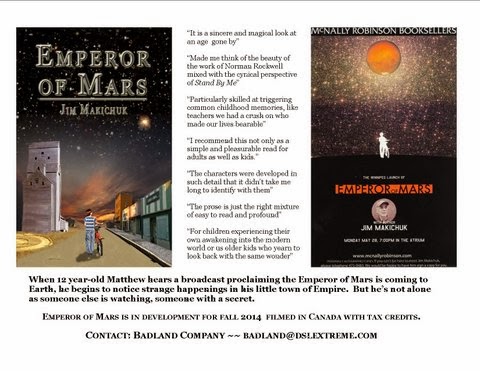
I made a "flashcard" of sorts, that I put into emails and send it, along with a 3-page proposal that contains story information, bios, locations, tax credits and other stuff packed into only 3 pages and in short paragraphs.

Back to the three efforts that went down;

The first attempt was around 1999 and even had an Academy Award-winning director, Xavier Koller who turned out to be a good guy. We all met at a nice little "boutique" agency in Beverly Hills and talked it over. It was dependant on getting money from Canada and I knew how that worked. And how it didn't.

The Montreal money guy seemed to think the Canada would supply all the funding. Anyone who knows how Canada's credits works knows that Canada supplies only a small percentage of funding. Needless to say, a week after I got a call that there was no money to be had in Canada that would cover the full funding.

Number 2 was the closest, we were actually almost in prep, I travelled to Montana to look at locations although we might have to film it in Alberta. But my producer Bill and the Alberta producers didn't really trust each other and then in the "final shot", Bill and his partner didn't agree with the funding people who apparently wanted a bigger take of the budget.

This is common when someone else finds the money, first they're happy to help, but when the $$$$ start appearing, they get a little hungry and ask for more, after all, they found the money.

So that went down.

And the last shot was ironically with the previous Alberta producers, one very slick and one who hardly speaks. I had business with these two previously where I actually won an option with them years ago (it's a small world) and didn't quite trust them. But not trusting a producer is like not trusting a rattlesnake.

I wasn't really sure why they wanted to make EOM and in the two years they optioned it, they didn't do a single thing. At least nothing that would indicate them wanting to make the film. That was 2009

So here we are - Joe and me -- Joe's doing a new budget of $2.6 million and I finished the cards and the mini-proposal and next week a full 10-page proposal with all that stuff that lawyers and accountants like to read.

Of which I can actually understand it too.

Shall we dance then...

Monday, February 10, 2014

Just what is it you do?


I get asked this a lot;

What is it exactly that you do?

I write.

Yeah but what does that mean?

A high school buddy of mine says I don't do anything.

I write about 4 - 6 hours a day and not only on a screenplay. Generally it works like this, starting each Monday:

Look at my "things to do sheet which I tape on a poster on the wall about 20 inches in front of me. That sheet is usually done late Friday afternoon and then I ignore it all week-end. I rarely write on week-ends, it's my own time.

But come Monday, it's looking at me, telling me it's time to get to work. It could be a screenplay or a proposal or email or go over new ideas or go over old ideas. Right now I'm not writing a screenplay so I tend to focus on a variety of things. Today's "things" are as
follows;

1. I have to finish a "flash card" for Emperor of Mars, which I'm trying to find funding for the movie version. This involves contacting producers and a casting agent and a distributor. And even completing a little bit of that is a big deal for one day.

2. Jule - the WW11 Pacific veteran. I'm arranging a time to interview him on camera as well as keep encouraging him to write his memoir.

3. My writer's book, The Working Writer's Screenplay, needs more pushing. I have to get copies out to universities and colleges. I already have two contacts.

4. Still trying to find a manager to get more of my screenplays out to buyers.

5. Need to write 2 outlines for two new ideas, one a movie idea, the other a TV series idea.

6. A list of very loose ideas including writing an article based on my deceased mother's calendars in which she wrote a little every day since 1971, her version of a diary.

7. Considering novelizing another screenplay.

So that's what I do, but the truth is I will probably not get all of this done through the next five days.  I didn't mention emails here, and that would take overall about an hour or so.

There's always a few people who say that it must be nice to just sit around and write. Well, I do like that, I never could work in an office but there's one thing that nobody else does that writers do...

We're always thinking about writing. Our job isn't 9 to 5, rather it's 24 hours. Even when I go out shopping I'm thinking about ideas. I have writing pads in every room and in my car. And I record any ideas on my phone if I'm out.

And I'm always looking at people wherever I go, watching something interesting or some action that people do. Keith Richards of the Rolling Stones says it perfectly in his book; that many sources of their songs came from watching other people.

So, unlike people who go to work everyday and come home to just hang out or fix the door, writers are always working. 

But my high school buddy still says "that's not really working."

He's a teacher, retired.

But now, I have to get started on the list, it's already 9:12am.

With miles to go.


Monday, February 3, 2014

The Black List


This is the 2nd part to my previous blog on readers. Just to make sure everyone knows what I'm talking about, readers in the film business are more often than not the people who judge our work. Remember that the only requirement is to be able to read. Or at least able to read a little bit.

As you can tell by my mood, readers aren't the most liked people in the business. And there is some envy by some readers as some of them are writers themselves, but who haven't been able to write a good story.

Take the Black List. This was originally the work of a reader who was a little bit better than most of his fellow readers. One year some time ago he decided to put out a list of screenplays he thought should be made but never were made.

As he didn't use his name, this became a yearly thing for him and did eventually cause some good screenplays being made. It wasn't long before everyone would read the Black List, as he decided to call it.

Last year, he decided on something else. 

He should make money from this.

So he did, he started a website where screenwriters could post their screenplays for studios and producers to see and maybe read. All for some money. And I don't feel bad about that in some ways.

But it certainly takes away the system that "used to be" and that was agents who would pass around new writers and screenplays for free. Well, sort of free, they would hope to sell the screenplays.

But as the number of aspiring screenwriters grows, the less contact they get with real agents who can push them into a career. Only problem is that the agent scene is smaller than it used to be as some of the big agencies swallowed the middle and smaller ones.

So the situation is this; more and more writers and less and less agencies.

If you read about my point of view on readers in the previous blog, you know how I feel.  And yes, I had a screenplay on The Black List and paid $40 for a reader's report, knowing full well that it could not work.

I got the report, the rider loved the premise, but found some areas that weren't "plausible." That's when I hit the roof, mostly because what I wrote was plausible. But now the reader's report can work against me.

And if that happens to me; it happens to a lot of people. You're giving your screenplay to someone who might trash it on the website. In a nice way, as they say.

But there are good readers; but very few. And that's where I can even show you what a good reader is.

I wrote a screenplay based on an idea by a director friend that was pretty much as far out there as I've ever written. The premise of the story is this:

An Irish hitman in the 1950's in Buffalo is sent to take out a gay union promoter inNiagara Falls but when he gets there he falls in love with a cojoined sister. Siamese Twins as they used to call them.

I had no experience with either gay union promoters or co-joined twins but I wrote what was considered a pretty good screenplay. And I had a woman reader who I really didn't want to deal with.

Until she wrote her notes.

And they were probably the best notes I've ever had or read. And she taught me a good lesson in the fact that not all readers are bad.

I am attempting to find out how to include her notes in the Materials and am having a hell of a time trying to figure it out.

Will get back in the week hopefully on this computer bug thing.
 

Friday, January 31, 2014

Reading readers


adj. plausible - credible, believable

One of the most disliked jobs in the film and TV business is probably "the reader".

These are the people who read screenplays for their production company or studio or producer. There's a couple of reasons why companies enlist readers; it could be the volume of screenplays a company would get and/or the producer is just too lazy and finally because the producer probably can't read because they never learned how to or they have an attention-deficit problem.

Having said that, there are a lot of producers who do actually read screenplays that are submitted or passed alone from a friend or another company or a studio.

But then there's the reader; you'll notice ads in places like Mandy and producers who are "too busy". There's actually two types of readers; one type is hired by the production company and the other is freelance. 

The production company will probably pay the reader a regular salary which may amount to

maybe a few hundred dollars a week. If the reader is good, they might rise to a development executive. With that label, they get business cards and probably the same amount of money.

Freelances are often made up of writers who haven't worked for awhile or aspiring writers who hope to make friends with the production company so they can have access to the producers with their screenplays.

So what do readers do?


Naturally they read screenplays, sometimes lots of them. And they have the power to either push a writer's screenplay further or the quash it.

The funny part about this is that most readers really haven't had any kind of training except for reading comic books for maybe even a real book or two. If I sound a little rough on these people, I'll tell you why --

Because screenwriters do not like readers.

How would you like it if you were a good pie maker and made a pie to someone who knows nothing about pie-making -- and he says it's not very good.

Okay, that's a weak comparison, but it is true.

Free-lance readers get paid anywhere from $10 a screenplay up to $100 (most of them at the bottom range).

I recently had a screenplay on The Black List and while the reader gave a glowing report to the overall screenplay, they expressed some doubts about the "plausibility" of one story line.

That got me going.

The scene in mind was a doctor who just happened to be in Paris and who witnessed a man having a heart attack and assisted the man to the hospital wherein CIA agents enlisted him for a special job.

There's more to the scene that explains why but let's go with that.

When questioned why the doctor happened to be there I answered simply "because he was" and "that's part of the story". Is it likely to happen? No. But could it happen? Yes.

It's very difficult to explain why; why did Bruce Willis in Die Hard happen to encounter terrorists when he just wanted to see his wife?  What's the odds of that happening to anyone?

How about Sandra Bullock in Gravity. Why did debris cast her off the space station at that moment? Astronauts regularly go out on space walks.  Why did it happen to her?

And how about a classic; Why does Ingrid Bergman and her husband come to Casablanca to escape the Nazis when the Nazis control Casablanca?

Does that make sense?

Is it plausible? I think Casablanca not plausible. Does anyone complain about it. No, the story is so good you don't look at logic.

Could a doctor from the U.S.A. come to Paris because he was kicked out of a hospital for drinking and decided to get out of the country for awhile and end up in a bar in Paris where someone has a heart attack?

Is it plausible that someone can fly like Superman? 

That's not plausible, at least for now.

While writers do not like readers because of the control they have over a writer's screenplay, readers don't always like us. A lot of them are envious because they are closet writers. It is a mutual non-admiration club.

I think the majority of readers give their producers want they want; that's why we see the same kind of movies over and over again, rom-coms (romantic comedies) and superheroes. 

Am I just grumpy, does it change anything... 

Part 2: Monday  The Black List


Monday, January 27, 2014

No more excuses...


And I mean it. Really.

Starting today I start on a project. Any project. Anything that strikes the muse, as they say.

But maybe I should take out the garbage. That's at least 5 minutes. Maybe I can find some other chore that takes longer.

The sun outside is shining early morning bright. It rained a little last night but as most of the time, it's gone by sunrise.

And this is how I spend Monday mornings, trying to figure out if I should start a project, finish a project or come up with a new project. Someone asked me what I do every day.

I look for work.

 As always I have legitimate projects to work on with the hope someone will buy one of them. But January is over in a few days and February is a fast month. You can see the previous blog to see what I'm playing around with.

This week, my Alberta producer will finish a new budget for Emperor of Mars, something around $1.6 million. Fifteen years ago the budget would have been $3.5 million but those days are gone. As I've said before, around 2005, TV movies, which I did most of my work in, started to disappear. Reality shows started in the form of Survivors.

And it took off. And at a lot cheaper prices.

And it became a buyer's market. Wherein Hallmark of Lifetime would have paid $3 million and more, they now pay around $350,000. 

Which is about 90% less.

Which means that producers have to scrounge around for money from anywhere, which means foreign countries, which means Canada and Great Britain, as most foreign language countries don't want our hundreds of Christmas movies.

And what about the crew?

You still need a sizeable crew to make a TV movie and larger for a studio-based movie.  How can a producer make a movie at 90% less cost?

They used to shoot TV movies in 4 weeks. 

Now they shoot them in 12 days. My Christmas story was made in 12 days. 

What does this mean?

You need to shoot and run. You can't do too many "over the shoulders" shots, and keep the cast small and fewer locations. 

And they can do it. 

But the only way to really make money is to be a producer like Larry Levinson, who makes 10 or 20 at a time. This way the company can get a cheaper rate for labor if the crews are guaranteed a year's steady work.

So what's the worst thing for writers;

We're being made minimum fees rather than fees our agents say we should have. There's always the privileged, writers who always work, but most of us trudge along and create our little projects that we hope someday will be bought.

And the funny thing is, some of them do get bought.
 

Friday, January 24, 2014

This and that


A little boy's postcard.

I've spend pretty much doing a lot of nothing, having handed in the screenplay I was assigned for, the one for the actor. He liked it alot and we even came up with a great title, which I would love to share but not until the screenplay is registered.

I don't usually register my screenplays, but sometimes, if you think you have something really unique, it's best to do that.

I know everyone says "they're gonna steal your idea", but in the last 23 years I've lived here nobody's stolen any ideas from me. And I pass around my screenplays to anyone who'll take it. 

Hell, I'll stand on a streetcorner and hand out the damn things.

Some writers I know, and don't really give a damn about, always say they never show their spec scripts to anybody except the big guys.

Well, the big guys don't give a damn and if you don't show your screenplay to a lot of people, you just might not get it read.

And never get it made. 

The last week of January is always the time I try to get something going. I usually get at least two or three deals by now, of which they will mysteriously fall away within a month or two.

There is the possibility I might get an actual writing assignment for a story that's just been published but it's not certain so I don't hold my breath.

But there's always the bear.

Yes, Gentle Ben, that bear movie that some of you cringe at, but the one who consistently brings me a few bucks now and then. Usually around $500-600 a year, sometimes more, in residuals. That money for free as I always say.

In fact I'm thinking of doing another, hell, the bear is ready for a new version. So towards this I'm finding out who has the copyright and then try to make a deal for an all-new Ben.

But another year is here, and another year for disappointments and great things and maybe I get to make either Ghostkeeper or Emperor of Mars. 

The great thing is, you never know.

So what's the photo above? 

I recently found it, it's a post card that I never mailed, but wherein I wanted to find out the name of a pretty actress in a movie with Hal March, a 1950's comic. So many years later, I read it and found some comfort in the fact that I was doing what I was doing years ago.

Trying to get into the movies.